

In 2021, the general manager of a small community FM station in Asheville, North Carolina bought a new car. The car had an HD Radio-equipped infotainment system — the kind that shows album art, station name, call letters. Standard stuff. She started driving around and noticed her screen was showing the call letters of a Charlotte station. A big one. On the same frequency. About a hundred miles away.
She hadn’t changed the station. Nobody had. The radio just decided.
That’s HD Radio digital capture. Not a glitch, not user error, not a transmitter malfunction. The receiver found a digital signal and locked onto it — the same way it was designed to. The car was working correctly. Her station was gone.
The station is WPVM-LP, 103.7 FM. 100 watts. The one doing the capturing is WSOC-FM, Charlotte, 100,000 watts. Same frequency. The WPVM general manager, Davyne Dial, documented the experience and reported it to Radio World. Xperi, the company that owns the HD Radio technology, said they had received no official report and could not comment without one.
Most listeners don’t know a thing about this. They hear the wrong station and assume that’s just how radio works.
What HD Radio actually does
HD Radio is an in-band on-channel system — IBOC, in the technical shorthand. Instead of putting digital radio on a separate frequency like DAB does in Europe, it embeds digital carriers right alongside the existing analog FM signal. Two sets of OFDM sideband blocks, one on each side of the analog host, running at a fraction of the analog power. At the standard injection level, the digital carriers run at about one percent of the analog station’s rated power.
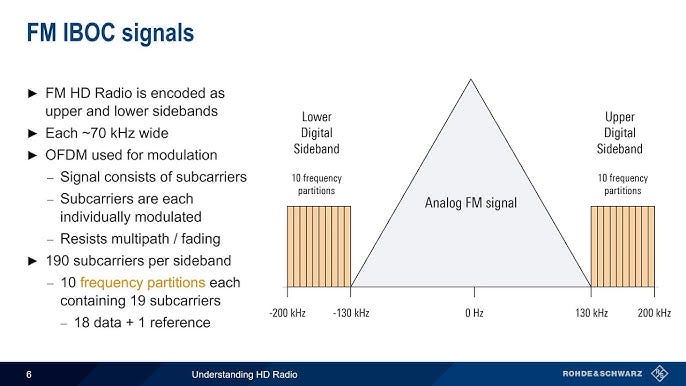
The pitch was that this would allow a smooth transition to digital without displacing analog stations from their frequencies. One transmitter, one antenna, both signals. Receivers that couldn’t decode HD would just hear the analog. Receivers that could would get digital audio, metadata, album art, potentially multiple subchannels.
The system was developed by iBiquity Digital — now Xperi — and selected by the FCC as the de facto US digital radio standard in 2002, without a competitive evaluation of alternatives. The major broadcast groups backed it. The standards body is NRSC. Chips went into cars. It has been rolling out slowly ever since.
The part that wasn’t fully reckoned with at launch is what HD receivers do when they find a digital signal from a co-channel station.
The co-channel problem
FM frequency planning protects co-channel stations — stations on the same frequency in different cities — by geographic separation. The FCC requires enough distance between them that in normal analog propagation, the weaker signal fades out before reaching the stronger station’s listeners. That math has worked fine for decades.
HD Radio breaks the assumption. An HD receiver isn’t comparing analog signal strengths. It’s looking for a digital carrier, and when it finds one, it latches. The receiver doesn’t know or care whether that digital signal is coming from the local station or from a co-channel station three states over. If the distant station’s digital signal crosses the capture threshold before the local station’s digital signal does -- or if the local station isn’t running HD at all — the distant station wins.
John Kean, a consultant who did modeling for NPR Labs, worked out the field strength threshold for this. A co-channel station’s digital signal reaching around 35 to 40 microvolts per meter at a receiver location is enough to trigger capture, even when the listener is inside the local station’s protected service contour. The capture zones are real and predictable. They aren’t random fringe events.
The WPVM/WSOC situation tracks exactly. A listener in Asheville, inside WPVM’s normal coverage footprint, can still be reached by WSOC’s digital signal at sufficient field strength because 100,000 watts at 100 miles produces more than enough signal to clear that threshold in some vehicles in some locations.
The Buffalo case adds another dimension. WDCX, a 110,000-watt FM there, runs HD. Around Christmas 2022, their HD carrier went down. A listener reported being captured by a Canadian co-channel station almost immediately. WDCX’s own digital signal was the only thing defending its frequency territory against the Canadian station. When it failed, there was nothing left. The lesson there is that running HD isn’t just about getting your digital audio to your own listeners — it’s also about holding the ground. If you’re not there digitally, someone else might be.
The power problem
This is where the structural asymmetry becomes plain. WSOC’s digital sidebands at one percent of 100,000 watts are radiating roughly 1,000 watts of digital energy. WPVM’s entire transmitter puts out 100 watts total. The numbers aren’t close.
The FCC has been moving in one direction on this. In 2010, they raised the allowed HD digital power from the original -20 dBc level to -14 dBc — a four-fold increase in digital power for any station that wanted it. In September 2024, they approved asymmetric sideband operation, allowing stations to put more digital power on one side of their channel than the other, which has legitimate technical uses for stations dealing with a specific first-adjacent neighbor but also opens another door that resource-rich stations can walk through that 100-watt LPFMs cannot.
A company called Press Communications — a New Jersey operator squeezed between New York and Philadelphia — filed a petition for reconsideration of the 2024 order, arguing it leaves smaller Class A stations and LPFM operators exposed. Xperi and the major broadcast groups opposed it. The petition is pending.
No recourse
LPFM stations are licensed as secondary services. That’s a specific regulatory category that means, among other things, that they cannot claim interference protection against primary services. The FCC’s interference rules in this area were written for analog-to-analog scenarios. They don’t map cleanly onto digital capture, which isn’t interference in the classical sense — the receiver is working correctly, it’s just working in favor of the bigger signal.
There is no form for WPVM to file. There is no complaint process with a defined remedy. Per reporting in Radio World citing a Mass Media Bureau source, the FCC has received hundreds of IBOC interference complaints over the years and has never acted on a single one.
Davyne Dial found out about the capture issue because she bought a car with an HD system. Most LPFM managers didn’t get that prompt. Their listeners are in some cases hearing the wrong station right now and don’t know it, because the metadata shows call letters they may not recognize, and nothing in their experience tells them their local station has been replaced.
The receiver found a signal. The system is working as intended. That’s exactly the issue.


